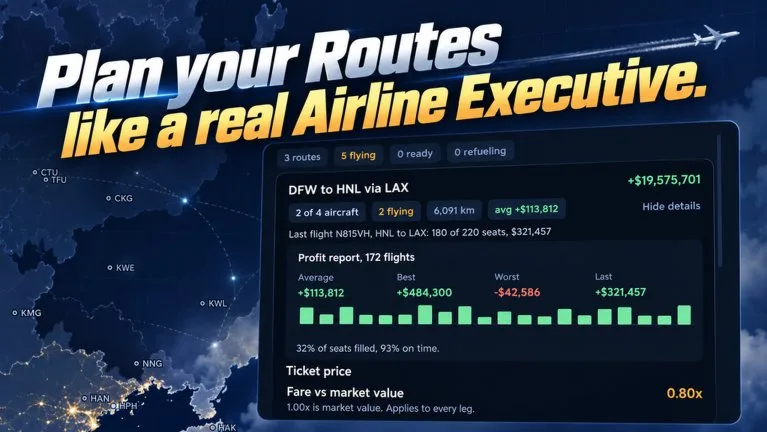
Route planning is three clicks plus a fare: buy the airports, draw the line, assign a jet that can live with the distance. The globe is the same map the studio describes as 1,100+ real airports, and official media calls it a 1:8 scale of Earth.
Draw the line
Rotate the globe and click a city node to see its purchase price. After you own both ends, click and drag the path. The line then shows on the network map and you can put a plane on it. Multi-stop routes chain more than two owned airports into one sequence, so a grounding in the middle cancels the later stops on that line.
Official route art shows the card layout with a worked example, DFW to HNL via LAX:
| Field on that card | Value shown |
|---|---|
| Distance | 6,091 km |
| Aircraft on the route | 2 of 4, with 2 flying |
| Header counts | 3 routes, 5 flying, 0 ready, 0 refueling |
| Last flight | HNL to LAX, 180 of 220 seats, +$321,457 |
| Profit report, 172 flights | Average +$113,812, best +$484,300, worst −$42,586 |
| Reliability on that sample | 32 percent of seats filled, 93 percent on time |
Those dollars and percentages belong to that card. They are not the payout for every DFW–Honolulu operation. Another official globe frame marks a 1,472 km leg toward ARN. Use the card to learn which numbers the game will show you: distance, aircraft assigned, seat fill, on-time rate, best and worst trips, and the fare multiple.
Set the fare
The ticket control is labeled fare versus market value. 1.00x means market value and applies to every leg of the route. Dropping the multiple, as in the 0.80x example, fills seats faster and shrinks profit per passenger. The official experience text is the same idea in plain language: cheap fares fill seats but eat profit.
Raise or lower the multiple after you see a fuel move, not on a schedule copied from another airline. Fuel is priced per gallon on the HUD and changes by the minute, so a fare that worked at departure can lose the arrival.
Hub-and-spoke or point-to-point
A hub such as Atlanta, or Dubai in the same network notes, collects flights and sends them out again. A point-to-point pair such as Los Angeles–Seattle skips the hub and ties up a jet on that city pair alone. Short spokes on a used 737-200 turn cash over faster. An Airbus A350 example in the same notes is Atlanta–London Heathrow, which needs the Heathrow purchase and a long-haul aircraft. An Airbus A330 example is a mid-range international leg such as Atlanta–Rome.
While the line is airborne
Click the aircraft for passenger count, tail number, progress, condition, and wind. Flights keep moving through day and night at 60X. They do not pause for a local curfew. If the header shows aircraft refueling, that tail is not ready; the sample card happened to show zero refueling.
Airport-by-airport notes are in the airports wiki. Solvency checks are in Cash, fuel, and bankruptcy.